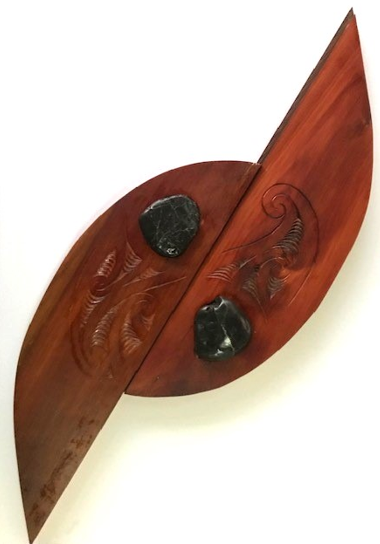
 The concept of the piece (as imaged on the right) was offered by Pā Piripi Cody SM and was inspired by Jacob's Covenant with Laban
... and also Mizpah, because he said, "May the Lord keep watch between you and me
when we are absent from one another" [Genesis 31:49]
The mauri is formed at its base by two pieces that sit apart but always belong together. Sarking from the Pukekaraka Mission House provides the base, that could stand alone, but clearly has a mate. The sarking is significant because it was built as a kainga (home) for the Society of Mary in 1897 which tangibly demonstrates a commitment to the original invitation from Ngāti Kapu to share the whenua of the Catholic Faith.
One tohu, three clear partners which sit in two pieces to come together as one.
Pā Pita Healy SM created the form by preparing the foundation, the sarking base. He then located two stones from the Ōtaki river. Chris Gerritzen polished them and bevelled seats for them in each of the two pieces.
Finally, the symbolism distinctly Māori, traditional Maori caring forming a design created by Chris Gerritzen. The design is Pūhoro which represents strength, agility, and speed. The first piece (left side of adjacent image) will remain with Pukekaraka.The carving depicts the Father, Son, and Holy Spirit. The second piece (on right side of the image) represents the Church and her people. All presented in the pūhoro pattern. Running through the centre which will guide the two pieces when they are returned as on is the manawa (the heart). The carving was completed by Brian Climie.
One piece will be cared for by the Archbishop and his vicar Māori, the other by Ngāti Kapu ki Pukekaraka.
Ngāti Kapu would have the taonga placed as of right in the church or at Hine, to remember the covenant at all events. When the Archbishop or his office returns to Pukekaraka (or vice versa), both pieces would be returned together at the celebration or event and it is expected that the story of the covenant is shared so that we all remember.